

Forward-Thinking Use of AI
rtificial intelligence is transforming the way the world works — and Slippery Rock University is ensuring its graduates are ready to lead that transformation. Few people understand AI and how students can leverage this emerging technology in their careers like Sam Thangiah, Ph.D., SRU professor of computing and security and director of the University’s Artificial Intelligence and Robotics Lab.
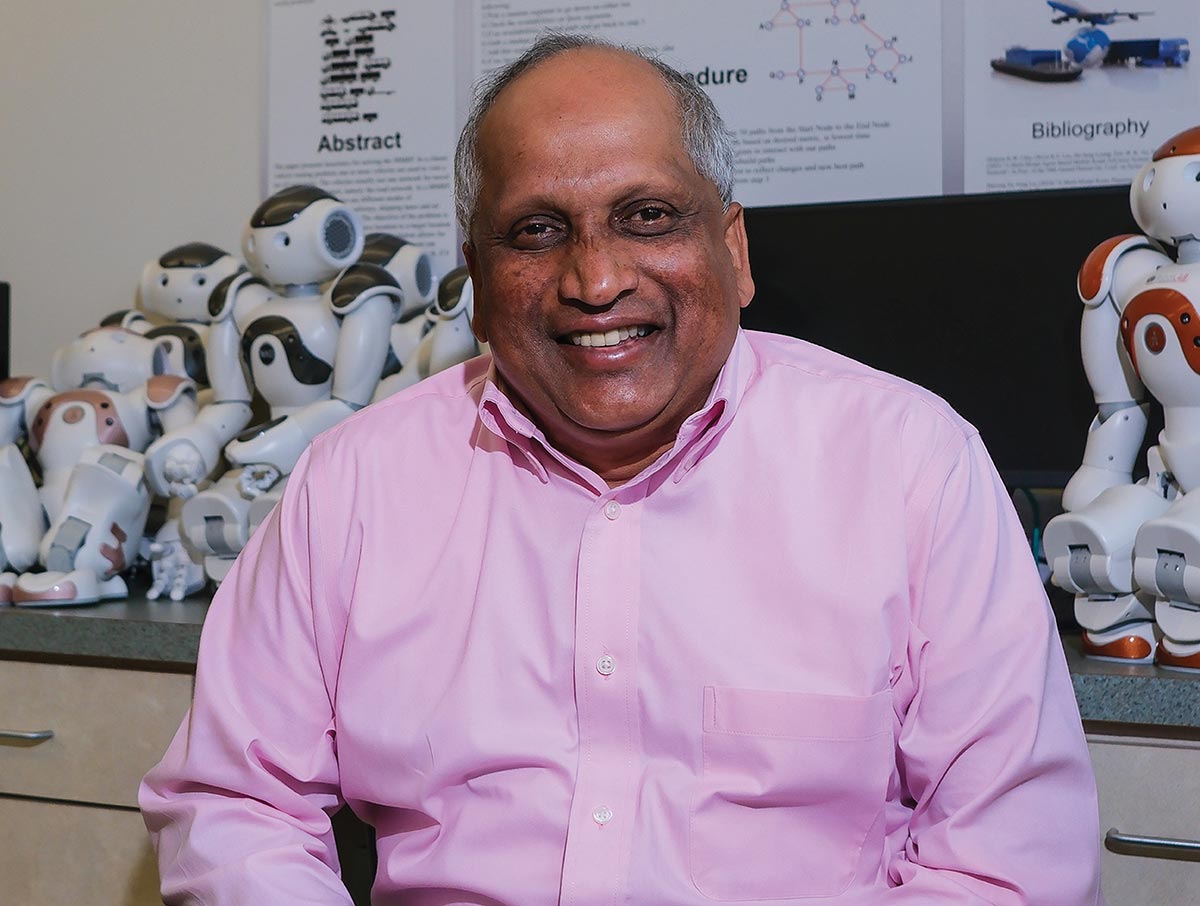
Thangiah has become a recognized expert in developing artificial intelligence algorithms to solve complex transportation problems, specifically vehicle routing and scheduling problems that have saved school districts up to 20% on their transportation costs through greater efficiency.
Defining AI
“AI is best and most often used for solving unstructured problems,” Thangiah said. “Structured problems are when you go through a sequence of steps to solve it, and every time you give it an input, you’ll get the same output. AI is unstructured so that if you give an input, you could end up getting different outputs for the same input. Artificial intelligence algorithms should be capable of learning and adapting.”
Supporting faculty who equip students with the skills to lead in rapidly evolving fields.
“AI isn’t just for coders or computing majors,” Thangiah said. “It’s impacting a large number of majors and professions.”
Examples include the banking industry using AI for detecting and preventing fraud and doctors using AI to read X-rays and scans to identify and diagnose health problems that they might have missed previously. One of the recent milestones in medical science involves protein folding, which is the process by which a protein chain twists into its correct 3-D shape so it can work properly. This application is important because misfolding can cause diseases like Alzheimer’s, Parkinson’s and cystic fibrosis.
Shifting Skills
“AI is going to have a large impact on the workforce, because any job that is repetitive in nature is most probably going to get replaced by AI,” Thangiah said. “Everything from manufacturing to customer service, even to point to where there will be robots flipping burgers.”
That doesn’t mean opportunities are disappearing. Instead, they’re shifting toward higher-level work that requires creativity, critical thinking and the ability to build and manage intelligent systems. SRU’s curriculum reflects that reality by embedding AI methods and models into computer science, cybersecurity, information technology, and data analytics courses.
“Employers want graduates who can communicate, collaborate and innovate; it’s not just about knowing the theory,” Thangiah said. “Here at SRU, our students are learning how to implement AI models, work in teams and present their solutions. These are skills that make them stand out to companies looking for more than just academic knowledge.”