

Prepared to Care
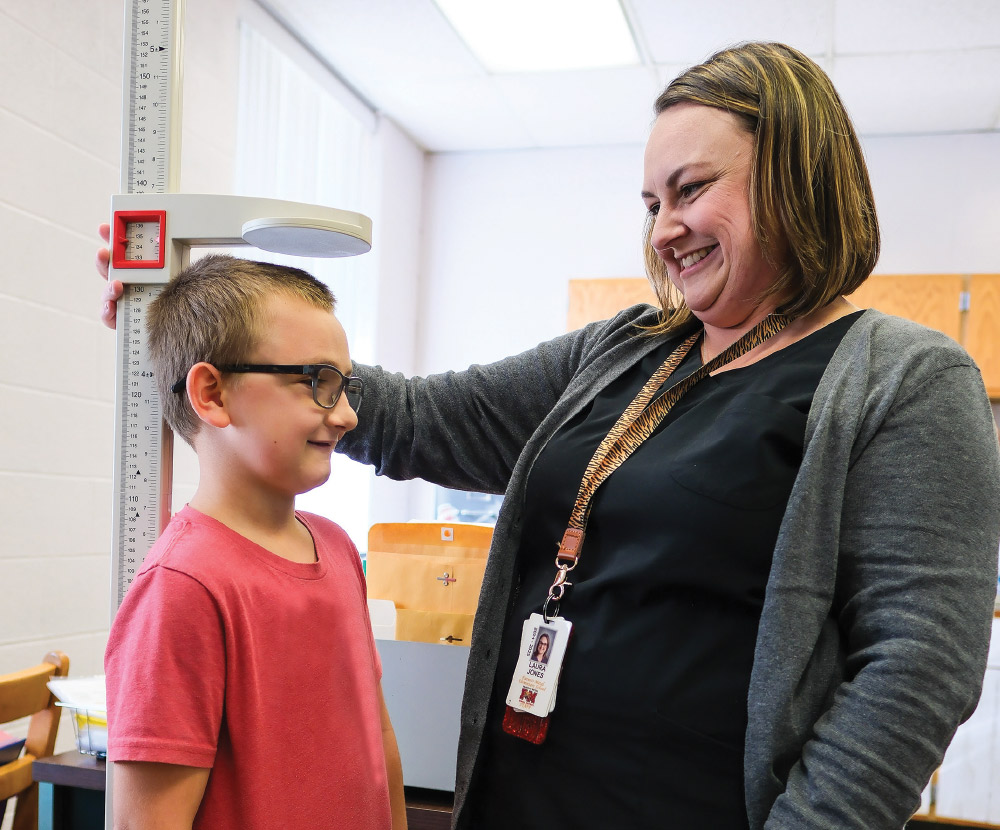
he nurse’s office at Fannett-Metal Elementary School in tiny Willow Hill, Pennsylvania, could be any clinic or doctor’s office in a small town. It’s where health care is practiced and lived every day by people like Laura Jones, ’25, a Slippery Rock University graduate with a Bachelor of Science in nursing.
Jones epitomizes the values of health care workers, what it takes to persist and thrive in the field and the personalized attention that they provide for people in their communities.
“I like caring for others,” Jones said. “I like seeing people get better and seeing them get what they need, but also helping people when it is their darkest day, holding their hand and getting them through it. It’s being able to help a mom have a baby for the first time. It’s being with that patient after they’ve had a heart attack and helping them understand what happened and what we need to do.”
There is a great need for many different health care professionals, but the need for nurses is particularly acute. Pennsylvania is facing a critical shortage of nurses, with recent reported vacancy rates of 30% for registered nurses who provide direct care, and an anticipated shortfall of more than 20,000 RNs in the state by 2026. These statistics are among the highest in the nation.
“There are vast opportunities in health care — people are living longer, but there are more chances of them being sicker — and we really need people for these jobs,” Jones said. “We all hope to be in the best health, but someday everyone is going to need others to step up.”
Jones has worked as a nurse her entire adult life and recently became a school nurse. The work can be routine, like applying a Band-Aid on a knee skinned during recess, but the work of school nurses also includes tasks that are consequential to early success, like understanding a child with special needs and their individualized education program (IEP), and providing appropriate care and medications. It can also be as serious as cancer, like when Jones noticed a kindergartner limping slightly and notified his parents to look into it before they discovered he had leukemia. Luckily, it was detected early enough for the boy to receive successful treatment.
The Nurse’s Call
When her youngest child started kindergarten in 2022, Jones decided it was time to return to her professional career, this time as a substitute school nurse at her children’s school, Fannett-Metal, and eventually full time — but her career growth was limited.
Although Jones is a registered nurse, she needed a bachelor’s degree to become a certified school nurse. Fannett-Metal has one on staff and Jones was able to work there on the condition that she pursue her BSN, which can be challenging for a working mother of four. Two colleagues recommended SRU’s online RN-to-BSN program, which is designed to meet the needs of registered nurses like Jones who are looking to build on their associate degree or diploma education and earn their BSN while working in the field.
SRU helped me to grow in my career. Having that degree on my wall at work, that is something that I show my kids that I’ve really worked hard for.”
“The difference that we have at Slippery Rock is we get it — we provide great support for students because we understand where they are,” said Christina Silva, associate professor of nursing, who, like Jones, earned her degree while working as a nurse earlier in her career. “I bend over backward to help our students, because I am their best resource.”
Jones benefited from the curriculum that is focused on skills such as teambuilding and communication, which are sought after by potential employers.
“SRU helped me to grow in my career because I was able to collaborate with other nursing professionals, improve my assessment and research skills and better manage my time,” Jones said.
PA who Communicates
Christine Karshin, dean of the College of Health Professions at SRU, meets regularly with hospital executives and nursing administrators. Each health professions department has its own advisory board of health care professionals who collaborate with faculty as strategic partners to achieve mutual success for graduates and employers.
“We’re hearing what the industry is telling us,” Karshin said. “Yes, they need more people in different disciplines, but it’s also about how we can better prepare our students to become the next generation of health care providers.”
An example of this is the physician assistant studies program at SRU, which requires students to complete a rotation focused on providing care to special populations.
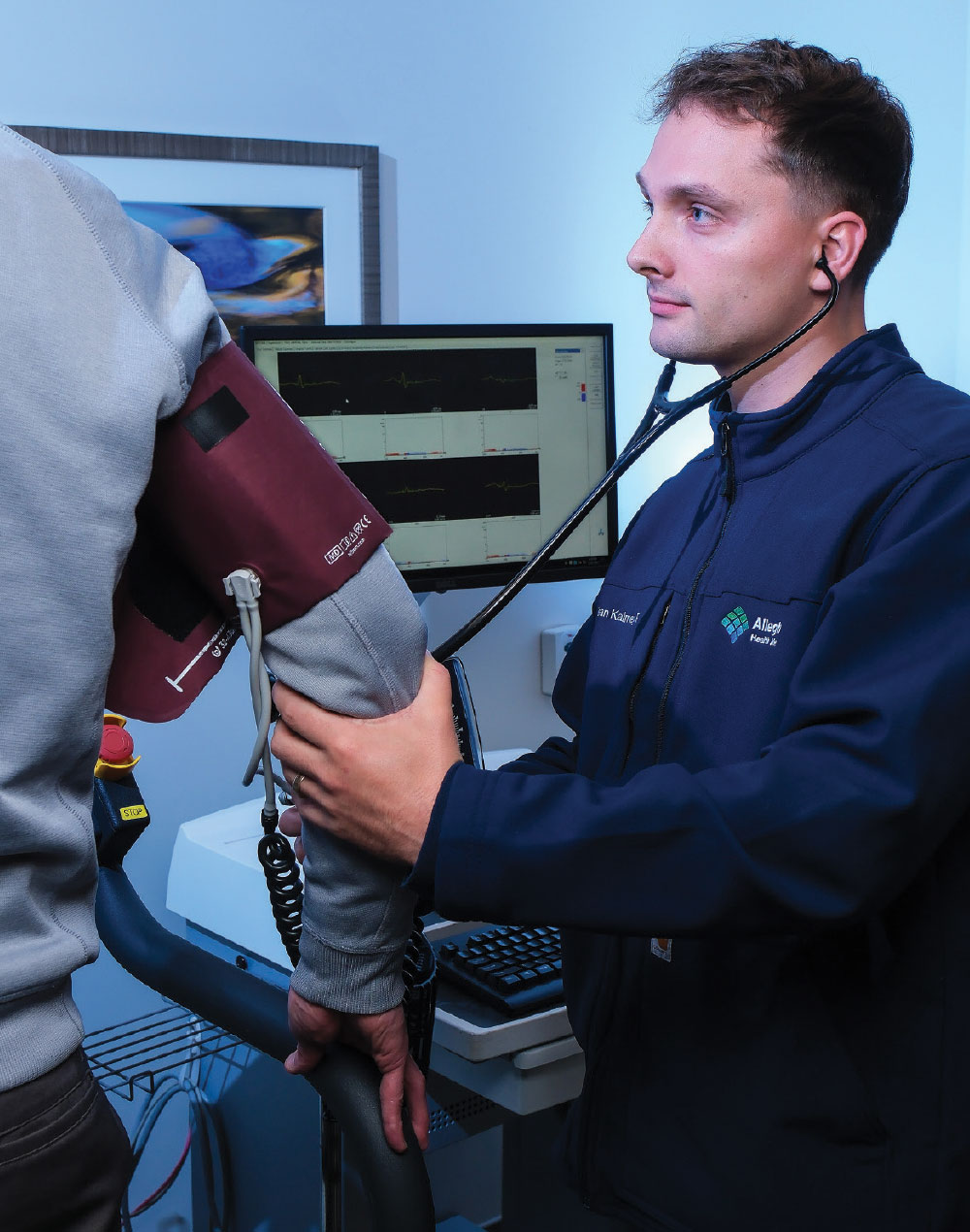
When Sean Kalmeyer, ’20, ’22M, was in SRU’s PA program, his field experience was in a neurocritical intensive care unit in rural West Virginia.
“Slippery Rock does a very good job at fostering a type of environment where you become aware of different cultures and develop a deeper understanding of differences in needs or even different opinions, beliefs and values,” Kalmeyer said. “Your approach to care can be different (depending on the patient’s background), but the goal is always giving the best guidelines based on recommendations. That’s why effective communication skills are so important. SRU prepares students for good, evidence-based decision making, but also good, shared decision making.”
Kalmeyer is now a physician assistant for Allegheny Health Network in Wexford, specializing in cardiovascular medicine. He maintains long-term relationships with patients in an outpatient clinic twice a week, as well as inpatient work diagnosing and managing care for patients with a range of cardiovascular conditions, including arrhythmias, heart failure, hypertension, hyperlipidemia and other heart-related diseases.
He remains involved with the SRU PA program, assisting in precepting students and giving lectures.
OT who Collaborates
SRU graduates like Gina Novario, ’17, ’21 DOT, know this well. She is a practicing occupational therapist who is now working as a research scientist at the University of Pittsburgh, where she is researching ways smart home technologies can be used as assistive technologies for persons with disabilities to promote independence and participation in daily tasks. She works with not only occupational and physical therapists but software and rehabilitation engineers.
“I have to lean on my team to solve problems, but even in my clinical job, I’m working with all different therapists, nurses, and case managers, so it’s incredibly important to maintain an open line of communication,” Novario said. “This is the best way, not only to support yourself in your career, but then also to support your patient to make sure they have the best outcomes.”
“It’s about personalized care, not generalizing problems and solutions,” Karshin said. “It just takes one person with the knowledge and the ability to make connections — the type of person who’s capable of seeing something in their patients and can do something about it. We have a whole college of people that we are preparing to be just those kinds of people.”
Prepared for the Future
Jones not only has developed the skills to be a better nurse, but she now has the credentials to back it up. She is positioned to become the certified school nurse at Fannett-Metal or to advance in other areas of the nursing field. Because nurses are needed in hospitals, clinics, schools and even on cruise ships, Jones could take her skills anywhere.
“SRU helped me to grow in my career,” Jones said. “Having that degree on my wall at work, that is something that I show my kids that I’ve really worked hard for, and they saw that I worked hard for it.”
“I was told at one point that I would never be a successful nurse,” Jones added while unsuccessfully holding back a smile. “I would think at this point that I am quite successful.”


Nursing at SRU
The program is nationally accredited by the Commission on Collegiate Nursing Education through 2034.
SRU introduced a 1+2+1 nursing program in Fall 2025 where students:
Scholarships to support the next generation of nursing professionals are available thanks to a transformative $500,000 gift from Art Williams, ’64, in memory of his late wife, Louise Williams: The Louise and Art Williams Scholarship.